
Quick answer: Yes, wedding photo booths are still popular—but the experience has evolved. Couples are moving away from generic backdrops and overflowing boxes of random props toward curated styling, professional portraits, physical keepsakes, digital sharing, video, AI-assisted photo experiences and interactive concepts that feel intentional within the wedding.
If someone told me that photo booths were popular ten years ago but nobody cares about them anymore, I would probably laugh.
Snaptique has been creating photo booth experiences since 2014. We now work more events—and more weddings—than we did during those early years.
Some of that growth comes from being established in the Toronto wedding industry and having stronger brand recognition. But it also tells us something important about the experience itself.
The photo booth did not disappear.
It grew up.
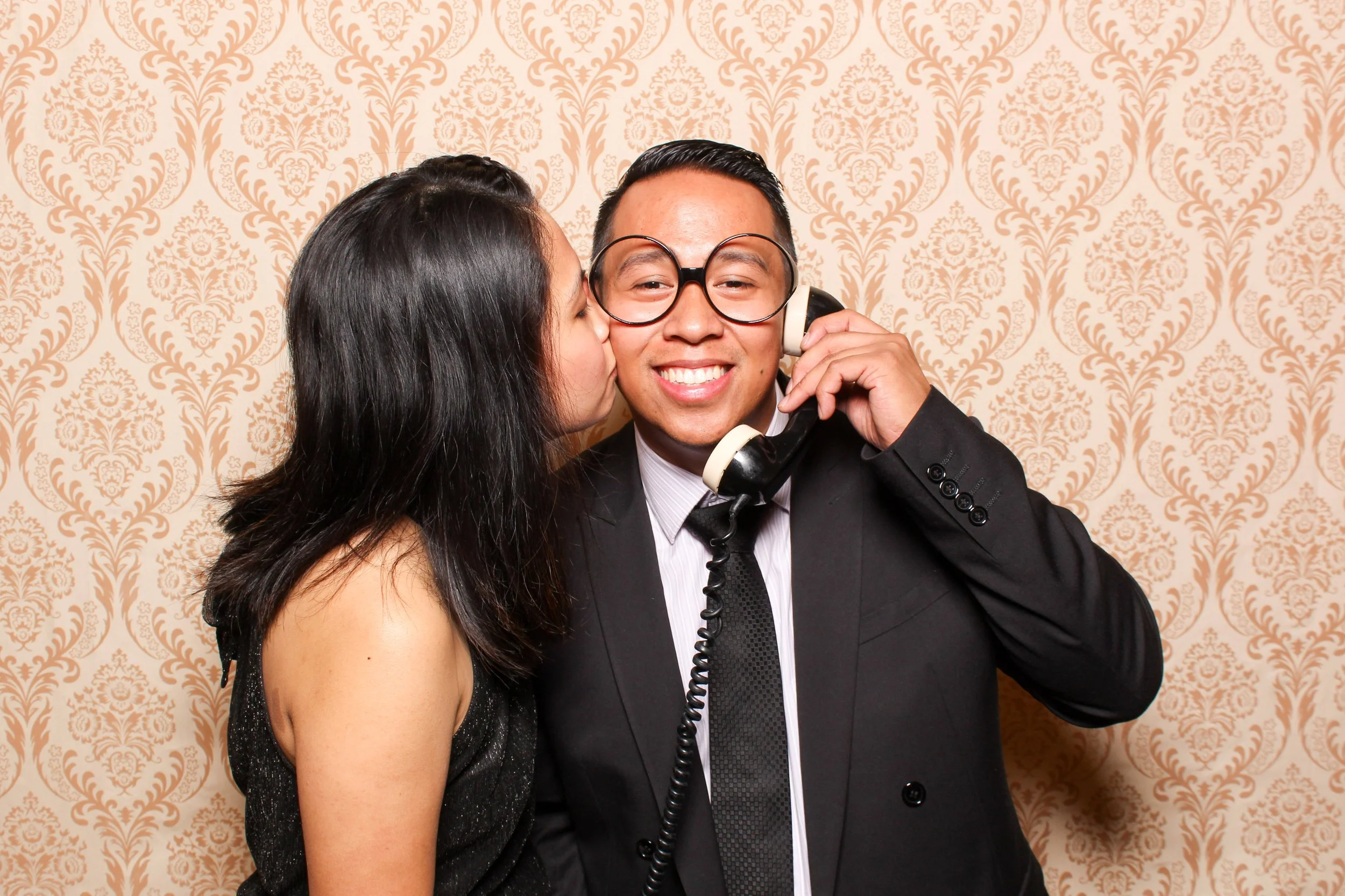
What did wedding photo booths look like ten years ago?
When we started, damask patterns were everywhere.
Backdrops were often bright, whimsical and intentionally over the top. Prop tables could include giant glasses, feather boas, moustaches on sticks and an assortment of objects that did not necessarily have anything to do with the couple or the wedding.
Some of it was wonderfully playful.
Some of it would look a little cringeworthy now.
At the time, that was part of the appeal. The photo booth was supposed to feel separate from the polished wedding photography happening elsewhere. Guests could put on something ridiculous, squeeze into a picture and leave with a strip of photographs documenting the chaos.
The fun has not gone away, but the styling has changed.
Over the last several years, we have seen a strong shift toward minimalism. Couples began choosing cleaner backdrops, simpler print layouts and fewer props. Instead of dropping a giant mixed box onto a table, we moved toward more curated wedding prop sets with signs and a smaller number of cute pieces that photograph well and do not make the setup feel messy.
Custom props are still available when a couple has a particular theme, joke or idea. The difference is that the props are now more likely to feel connected to the wedding rather than added simply because photo booths are expected to have props.
Are photo booths actually still being booked for weddings?
Yes.
Snaptique books more weddings now than it did ten years ago, and wedding-industry research continues to treat photo booths as an active form of guest entertainment.
The Knot's 2023 Real Weddings Study surveyed nearly 10,000 U.S. couples. It found that 75% considered the guest experience a crucial part of planning. Among couples who included additional guest entertainment, photo booths were the leading selection at 61%.
That does not tell us the percentage of Toronto weddings with a booth, and we would not present U.S. survey findings as a Canadian booking census. It does show that photo booths remain a recognized part of the wider wedding-entertainment category.
More recent trend reporting points in the same direction. WeddingPro's 2025 wedding trends includes photo booths within the rise of immersive, entertainment-first guest experiences. The Knot's 2025 wedding-technology trends highlights 360 video booths and GIF stations, while its reception-trend coverage points to continued interest in interactive photo guest books.
The format is not frozen in 2014. That is part of why it remains relevant.
Why do guests use a photo booth when everyone has a phone?
Phone cameras did not replace photo booths because the two do not create the same experience.
A phone is usually personal. Someone pulls it out, takes a picture and puts it back into a pocket. The image may be texted to two friends, posted once or buried in a camera roll containing thousands of other photographs.
A photo booth is shared and intentional.
It gives guests:
- A specific place to gather
- Professional or purpose-built lighting
- A camera positioned for the experience
- Direction from an attendant when one is included
- A backdrop or environment designed for the photograph
- A reason for people who may not know one another well to interact
- A finished output, rather than another image waiting to be dealt with later
Most importantly, many of our booths can print the photograph immediately.
Guests rarely go home from a wedding and print a selection of phone pictures, even if they own a printer. Digital images tend to remain digital.
A photo booth print is already complete. It can go onto a refrigerator, desk, mirror or bulletin board. It is a small physical reminder of the people who were together that night.
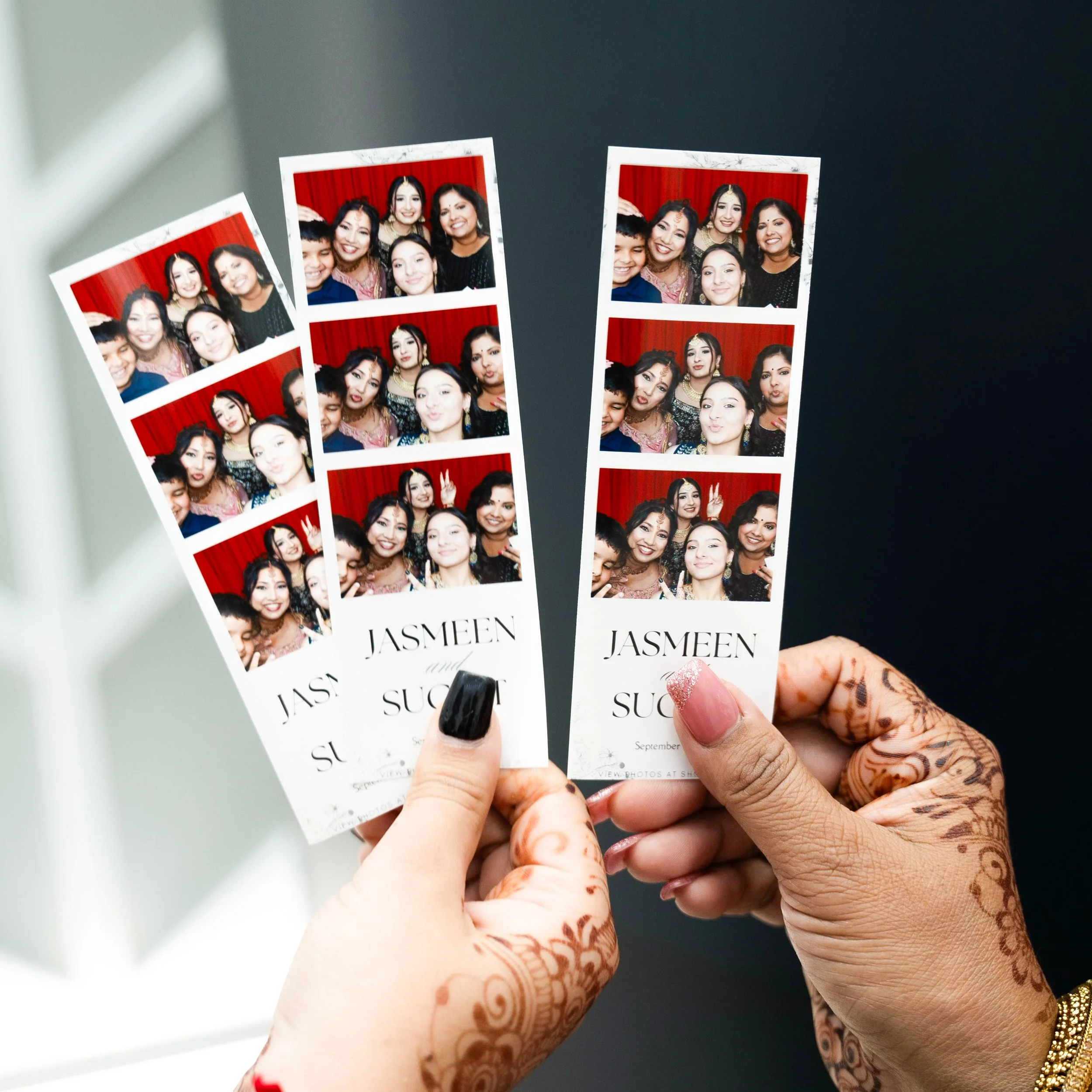
Physical prints still matter
The ability to take something home is one of the strongest reasons traditional print booths continue to have a place at weddings.
Prints also change what happens around the booth itself.
Guests often remain nearby while the photograph prints. They look at it together, laugh about a pose, show it to other people and decide whether to take another one. The output becomes part of the social moment rather than something viewed alone on a phone later.
When a guest book is included, a second copy can be placed into the book with a handwritten message for the couple. That gives the newlyweds a collection of photographs and notes created throughout the reception—not merely a digital gallery they may look through once.
Digital sharing can still be offered alongside the print when the venue has suitable connectivity. Couples do not necessarily have to choose between a physical keepsake and something guests can save or share.
What makes a wedding photo booth feel dated?
The concept itself is not what usually feels dated.
The execution can.
A booth is more likely to feel gimmicky when:
- The backdrop has no connection to the wedding
- The prop table is overcrowded or messy
- The graphics use outdated patterns simply because they were once common
- The equipment looks temporary or poorly maintained
- The experience is placed in an awkward corner
- Guests do not understand what they are supposed to do
- The final photographs look noticeably worse than ordinary phone pictures
One trend article from Vogue described couples moving away from traditional photo booths toward more sophisticated and distinctive ways of photographing their guests.
We do not read that as the death of the photo booth.
We read it as a higher expectation.
Couples still want guest photographs, interaction and keepsakes. They simply want the experience to look intentional, produce strong content and feel appropriate for the wedding they are planning.
What makes a photo booth feel current?
A current wedding photo booth does not have to use the newest technology available.
It needs to feel considered.
That may mean:
- A wooden Vintage Booth in a whimsical garden setting
- A clean white Modern Booth in a minimalist venue
- A Classic Enclosed Booth styled for an elegant reception
- A trailer booth that becomes part of an outdoor environment
- A professional portrait setup with flattering lighting
- A curated prop collection instead of a chaotic assortment
- A backdrop that carries the wedding's colour, texture or atmosphere
- A digital experience designed around movement and sharing
Timeless and current are not opposites.
A simple, beautifully lit photograph can feel more modern than a complicated effect that has no relationship to the event.
Drapery and layered backdrops are returning
Minimalism is still present, but wedding styling is beginning to become richer again.
We are seeing more drapery, layered fabrics and backdrops that combine a printed or scenic surface with fabric in front of it. Instead of returning to the busy look of older photo booths, the new version uses texture, depth and movement more deliberately.
This is not only something we are noticing at Snaptique.
ELLE Canada identified the return of draping as a Canadian wedding trend. Vogue's coverage of wedding drapery described fabric evolving from a practical way to conceal a wall or tent pole into a design feature in its own right.
For a photo booth, that can mean the backdrop is no longer merely a flat surface behind the guests. It can become part of the wedding design while still keeping the people in the photograph as the focus.
Video experiences have expanded the category
Not every modern photo booth creates a still photograph.
The 360 Video Booth invites guests to stand together while a camera arm moves around them. It works especially well for energetic groups that enjoy dancing, posing and creating social content.
The GLAMBOT™ uses a robotic camera arm and high-frame-rate capture to create dramatic slow-motion video. It gives guests an individual spotlight moment closer to a red-carpet or editorial production.
These experiences stay relevant because they create something that is difficult for a guest to reproduce by simply holding up a phone.
They do not replace professional print booths. They serve different goals.
A mixed-age wedding may still receive broader participation from an open-air print booth. A fashion-led celebration or high-energy evening reception may benefit from video. The right answer depends on the guests and what the couple wants the experience to contribute.
Portrait booths bring more editorial photography to weddings
Snaptique has created Portrait Booth experiences for clients before and is now formalizing the experience as a more visible product for couples who want a sophisticated way of photographing their guests.
The emphasis is less on novelty props and more on flattering light, direction and a polished portrait. This reflects the broader shift toward wedding experiences that feel editorial, elevated and visually connected to the event.
It is still interactive. Guests are still participating together. The difference is that the finished photograph can feel closer to a portrait studio than a traditional novelty booth.
This is another example of the photo booth evolving rather than disappearing.
AI can connect phone photographs, event images and onsite printing
Newer technology can also solve one of the biggest problems with digital wedding photographs: finding and printing them afterward.
At custom request, Snaptique can create an AI-assisted photo-finding and print experience. Depending on the event setup, guests can contribute photographs to an event gallery, use photo matching to locate images they appear in and visit a print station to select a photograph to take home.
That can bring together images taken in the booth and photographs captured elsewhere during the event.
The technology does not make the physical print less relevant. It makes it easier to turn more of the event's digital images into physical keepsakes before guests leave.
Because this is currently offered as a custom request rather than a standard website package, the workflow should be planned around the event's goals, connectivity and privacy requirements.
The Autograph Booth adds another kind of participation
The upcoming Autograph Booth gives guests another way to become part of the content.
Instead of only standing in front of the camera, guests can add a handwritten signature or message through the booth's screen. It brings some of the feeling of signing a yearbook, celebrity photograph or keepsake into a digital photo experience.
That interaction is simple, but it changes the role of the guest. They are not only the subject of the photograph—they leave their own mark on it.
Concepts like this keep the category moving forward while preserving the reason photo booths worked in the first place: people enjoy making something together.
Do all age groups still use wedding photo booths?
Yes.
Early in our business, I was sometimes surprised by who would participate. After more than a decade of events, I am not surprised anymore.
Children, grandparents, wedding parties, coworkers, cousins and friends all use photo booths. Different generations may gravitate toward different outputs, but participation is not limited to one age group.
Older guests may respond most naturally to a familiar photograph and physical print. Younger or more performance-ready groups may move quickly toward GIFs and video. Those are tendencies rather than rules.
We have seen every age group step in front of the camera once the experience feels welcoming and easy to understand.
What determines whether guests actually use the booth?
A great booth can still underperform if it is hidden or poorly timed.
Participation is influenced by:
- Placement near the action without being beside a loud DJ speaker
- A clear path that does not block a major walkway
- Enough space for guests to gather and watch
- Operating hours that match the natural flow of the reception
- A backdrop and booth that attract attention without overwhelming the room
- Clear instructions
- An attendant who welcomes people and keeps the experience moving
The person working the booth matters more than couples sometimes realize.
A strong attendant does not pressure people. They help guests understand the experience, invite participation, keep the area organized and make people feel comfortable in front of the camera.
For many weddings, cocktail hour and the period after dinner are especially useful operating windows. The right timing depends on the venue, schedule and guest count.
Are photo booths just another wedding trend?
Specific versions of the photo booth will move in and out of style.
Damask gave way to minimalism. Giant prop collections became curated sets. Flat backdrops are now being joined by layered drapery. Traditional prints exist alongside GIFs, 360 videos, AI-assisted galleries, portrait experiences and robotic cameras.
But the reason people participate has remained remarkably consistent.
Guests want something to do together. They want permission to be playful. They want a photograph in which they are part of the event rather than merely standing behind a phone documenting it.
And many of them still want to leave with something in their hands.
That is why the photo booth has lasted longer than any one backdrop pattern, prop style or piece of technology.
Frequently asked questions
Are wedding photo booths outdated?
No, but generic or poorly styled setups can feel dated. Current wedding photo booths use more intentional styling, curated props, professional lighting, prints, digital sharing, video and interactive technology.
Do people still use photo booths when they have phones?
Yes. A photo booth gives guests a dedicated shared experience, professional or purpose-built lighting, a designed setting and—when using a print booth—an immediate physical keepsake.
Are props still popular at wedding photo booths?
Props are still used, but many couples prefer a smaller curated collection rather than a large box of unrelated novelty items. Custom props can be created when they support the wedding theme or the couple's personality.
Are prints or digital photos more popular at weddings?
Both serve different purposes. Prints give guests something tangible to take home, while digital images, GIFs and videos are easy to share. Many couples choose a print booth that also offers digital sharing.
Are 360 booths still popular for weddings?
They remain a strong option for younger, energetic or performance-ready crowds that want short-form video. They are not automatically better than a print booth; the right choice depends on the guests and the desired atmosphere.
What is replacing the traditional photo booth?
The traditional booth is not being replaced by one single format. It is being joined by portrait booths, 360 video, GLAMBOT™, AI-assisted photo matching, digital galleries, custom sets and other interactive experiences.
How can we make a wedding photo booth feel elegant?
Choose a booth that complements the venue, use a considered backdrop, keep props curated, coordinate the print design and make sure the lighting and equipment look intentional within the room.
The photo booth did not disappear—it evolved
Photo booths remain popular because the underlying experience still works.
They bring people together, give guests something to do and create photographs that might not exist otherwise. Physical prints continue to matter, while new technology gives couples more ways to personalize, share and interact with the content.
The booth that belongs at a modern wedding may look different from the one we brought to an event in 2014.
That is exactly why it is still here.
If you are planning a wedding in Toronto and want an experience that feels current rather than generic, tell us about your venue, guests and the kind of photographs or content you want to create. We will help you choose a photo booth that fits the celebration now—not one that feels borrowed from a decade ago.
Author: Chantalle Gallego, Co-Founder of Snaptique Photo Booths First published: November 11, 2026 Last reviewed: November 11, 2026 Experience note: Based on Chantalle and the Snaptique team's firsthand experience designing and operating photo booth experiences since 2014.
